From Sampler to Story Cloth: Embroidery in Context
See how embroidery samplers recorded stitches and designs, while story cloths used images and symbols to carry personal memories and lived experience.
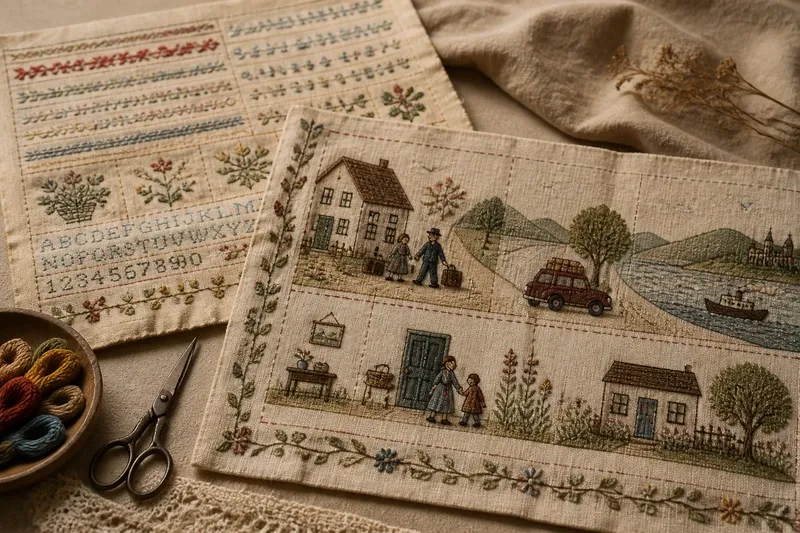
An embroidery sampler records what its maker wanted to learn or preserve; a story cloth uses stitched images to communicate an experience. The distinction is not simply about whether a piece contains words or pictures. It is about what the embroidery is organised to do: demonstrate a repertoire, or shape a narrative.
That difference helps when looking at an old stitched panel, planning a new project, or deciding what kind of piece to make. Samplers and story cloths can share fabric, thread, motifs and even lettering, but they ask the maker to make different choices. One arranges stitches as a record. The other arranges images as a sequence or account.
Two purposes, two structures
A sampler is a working record of embroidery. Its maker might practise a set of stitches, copy a pattern, preserve a family of motifs, or combine these purposes. Rows, grids and separate blocks are common because they make each sample easy to see and compare. Names, dates or short inscriptions may identify the maker or mark the piece, but the stitches and designs remain the main content.
A story cloth is organised around an account. It may show a journey, a family memory, a community’s experience or a scene from everyday life. Stitched figures, objects and settings become parts of a visual sequence. Words can clarify the account, but they are not essential: arrangement, repetition and contrast can carry meaning too.
These are useful distinctions, not rigid categories. A sampler can include a personal message, and a narrative cloth can display several stitches prominently. To read either one, look at how its parts relate. Does the layout invite you to inspect individual techniques, or to follow a sequence of events and symbols?
How samplers keep a record
The word sampler points to a sample: a piece made to gather and preserve examples. In different settings, makers used samplers to learn stitches, practise lettering, collect decorative designs, or keep a visible reference for future work. A sampler could be an exercise, a teaching aid, a record of skill or a combination of these.
Its layout often reveals its purpose. Repeated rows of stitches let a maker compare variations. A grid of motifs keeps patterns separate and legible. A band sampler may arrange designs in horizontal strips, while a more open composition gives each element its own space. Letters and numbers can serve as practice, identify a maker or record a household connection.
Materials and wear add clues, though they do not settle the question by themselves. Uneven spacing, corrections and unfinished areas may suggest practice, but a carefully planned sampler could be made for display. A well-preserved piece may have been protected rather than used often. Treat these details as evidence to consider alongside the layout, inscriptions and subject matter.
Samplers also preserved knowledge that could be reused. A maker could return to a motif or stitch instead of relying on memory alone. In a household or teaching setting, the cloth made that knowledge visible to someone else. Its record was practical: not just “this was made”, but “these are forms and techniques worth keeping”.
How story cloths carry meaning
A story cloth centres its organisation on what is being told. Scenes may follow one another across the fabric, cluster around a central figure, or use repeated motifs to connect moments. The maker decides which details deserve space and which can be left out. That selection is part of the account, not merely decoration.
Symbols may be personal, shared within a family, or recognisable within a community. A house can mark home, a road can suggest departure, and a repeated object can link separate scenes. But symbols do not have fixed meanings in every cloth. The maker’s context matters, and a viewer should not assume that a familiar shape tells the whole story.
Story cloths may be made by one person or by several people working together. In collaborative work, different hands can contribute images, words or sections, while the whole cloth gathers them into a shared account. The result can preserve experiences that might otherwise be told only aloud, though stitched narrative does not automatically make every detail transparent to an outside viewer.
Some narrative cloths also have a public or communal purpose, while others are intimate and meant for a small circle. Their scale, imagery and inscriptions can hint at the intended audience, but a private story may be shown widely later, and a public work can hold meanings known only to its makers. Read the cloth attentively without treating interpretation as certainty.
Which approach suits your purpose?
Choose a sampler if your main aim is to practise, compare or preserve stitches and motifs. It suits a learner who wants a reference for future work, a teacher gathering examples, or a maker documenting a personal repertoire. A clear grid or set of bands makes individual samples easy to locate, and brief labels can identify techniques without turning the cloth into a narrative.
Choose a story cloth if your priority is to communicate an experience through images. It suits a maker who wants to preserve a memory, represent a journey, or bring several people’s contributions together. Start by deciding what the viewer should understand or feel, then select a few scenes and recurring details that support that account.
A mixed approach can work when both purposes matter. For instance, a maker might place a small group of stitch samples around a central scene. The decision is whether the techniques remain subordinate to the story or the narrative serves as a setting for displaying stitches. If neither purpose is clear, the design may feel divided; choose which one should lead before adding detail.
Say you want to remember a family move. If you arrange rows of different stitches with a few house motifs, the cloth will read chiefly as a sampler with a personal association. If you show a departing house, a road and a new doorway in sequence, repeating a small stitched key in each scene, the same materials can support a story cloth. The visible difference is the organising idea, not the thread or the complexity of the sewing.
Reading a piece with care
When you encounter an unfamiliar work, begin with what you can observe rather than assigning a label straight away:
- Check the layout. Separate rows, grids or motif blocks suggest a record to consult; connected scenes may invite a narrative reading.
- Look for repetition. Repeated stitches may demonstrate technique, while a recurring object or figure may connect parts of an account.
- Read any lettering. Names, dates, alphabets and short labels can indicate practice or identification; sentences and captions may help frame a story.
- Notice corrections and variation. They can show learning, adaptation or deliberate emphasis, but do not establish the maker’s purpose alone.
- Ask what the arrangement asks of you. Does it invite comparison between samples, or encourage you to follow images from one area to another?
Keep these clues together. A single date does not make a piece a sampler, and a single figure does not make it a story cloth. If the maker’s own explanation survives, it can sharpen your reading; without it, describe what the design supports rather than claiming more than the cloth can tell you.
What should you make or notice?
Can a sampler tell a personal story?
Yes, but its main structure can still be a record of stitches or designs. A name, family motif or personal inscription adds context; it becomes a story-led piece when the images and their arrangement chiefly develop an account.
Do story cloths need written words?
No. A sequence of scenes, repeated objects and changes in setting can guide a viewer without captions. Words can supply names or context, but their absence does not make the cloth less narrative.
How can I distinguish a practice piece from a display piece?
Look at layout, labels, corrections and signs of use together, rather than treating neatness as proof. A polished sampler may have been made for display, and an informal-looking one may still have been carefully kept as a reference.
Can one cloth be both?
It can combine sampled stitches with narrative imagery. Decide which purpose leads by asking whether the viewer is mainly comparing techniques or following an account, then arrange the other elements to support that reading.
Let purpose shape the cloth
If you are making a sampler, keep its record useful: leave enough space to see each sample, label only what will help later, and arrange related stitches or motifs so they are easy to compare. If you are making a story cloth, give the images a readable order and choose recurring details that carry meaning for the intended audience. Neither approach needs elaborate materials; the choices that matter most are what to preserve and how to arrange it.
The sampler-to-story-cloth distinction is a practical way to understand embroidery in context. A sampler makes a repertoire visible; a story cloth gives stitched images a narrative job. When you identify that central purpose, you can make better sense of the work in front of you—or decide what your own cloth should say.